What are NYC rental assistance programs — and how do they help you stay housed?
NYC rental assistance programs are city, state, federal, and nonprofit resources that can reduce your monthly rent, prevent eviction, or freeze rent increases if you qualify. Whether you’re facing eviction, recovering from financial hardship, or trying to keep up with rising rent, programs like Section 8, CityFHEPS, NYCHA public housing, and SCRIE/DRIE can help bridge the gap and keep you stably housed.
Best For
Eviction risk or arrears
Prioritize emergency rental help, legal support, and CityFHEPS to prevent displacement.
Best For
Long-term affordability
Explore Section 8 vouchers, NYCHA public housing, and affordable housing lotteries.
Best For
Seniors & renters with disabilities
SCRIE and DRIE can freeze your rent permanently if you qualify — even as legal rents rise.
NYC Rental Assistance Programs Explained: What They Are and Why They Matter

Living in New York City can feel electric — there’s always somewhere to go, something to do, and a million reasons to stay. But the cost of housing? That part can hit hard, fast. With rising rents and a critically limited supply of affordable apartments, families across the city often struggle to keep up with monthly housing costs.
That’s where NYC rental assistance programs come in. These programs are designed to help low- and moderate-income residents maintain stable housing through financial support, rental subsidies, legal assistance, and housing counseling. Whether someone is facing eviction, recovering from financial hardship, or simply trying to keep up with rising rent, rental assistance helps bridge the gap.
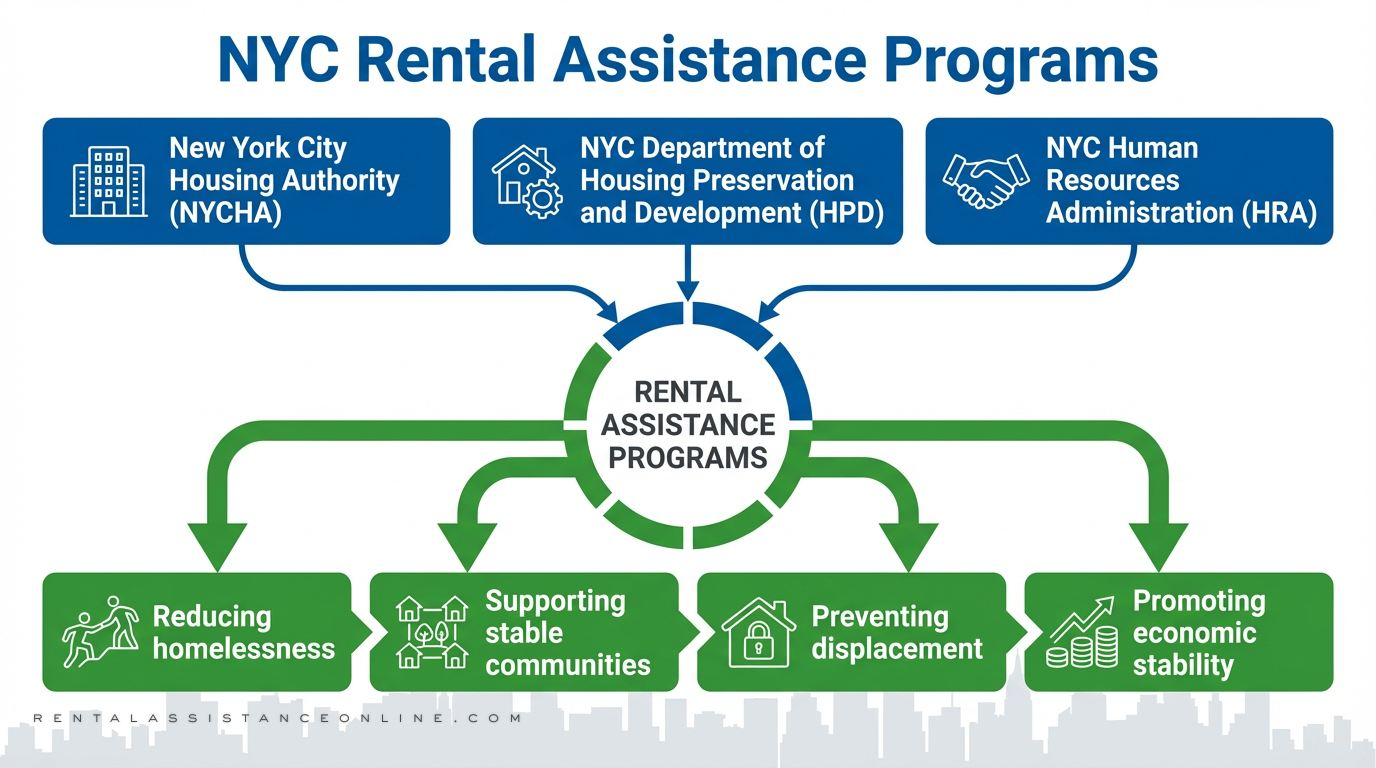
Several city agencies and nonprofit organizations collaborate to administer these programs, including the New York City Housing Authority (NYCHA), the NYC Department of Housing Preservation and Development (HPD), and the NYC Human Resources Administration (HRA).
NYC housing pressure — key data points
- NYC’s net rental vacancy rate stood at approximately 1.4% as of 2023 — a historic low recorded by the NYC Housing Vacancy Survey. Source: HPD
- Vacancy rates at the lowest rent levels (under roughly $1,100/month) are dramatically lower than the citywide average.
- NYC’s shelter census has exceeded 100,000 people nightly in recent reporting, underscoring why eviction prevention is an urgent priority. Source: Coalition for the Homeless
“This latest survey result shines a spotlight on what we know as New Yorkers — more people want to live and work in the greatest city in the world but are struggling to find housing that makes that possible.”
— Adolfo Carrión Jr., Commissioner, NYC Housing Preservation & Development (HPD)
Area Median Income (AMI)
A HUD benchmark used to set income limits for most NYC rental assistance programs and affordable housing lotteries.
Housing Choice Voucher (Section 8)
A portable rental subsidy that lets eligible households rent private apartments while the program covers part of the rent.
SCRIE / DRIE
NYC rent-freeze programs for eligible seniors (62+) and renters with qualifying disabilities that permanently stop future rent increases.
CityFHEPS
NYC’s City Fighting Homelessness and Eviction Prevention Supplement — a rental assistance voucher for households facing eviction or homelessness, paying rent for up to five years.
Beyond helping individuals, rental assistance programs also strengthen the city as a whole by reducing homelessness, supporting stable communities, preventing displacement, and promoting economic stability. These programs are a crucial safety net for thousands of households across the five boroughs. For real-world questions and practical guidance on navigating them, the Brooklyn rental assistance guide walks through how the city’s layered system actually works for renters on the ground.
NYC Rental Assistance Eligibility and Application Steps

Applying for NYC rental assistance can feel overwhelming — especially if you’re already stressed about rent, late notices, or what happens next. But once you understand the requirements and the basic flow of the process, it gets more manageable.
Common Eligibility Requirements
Although each program has its own rules, applicants generally must live in New York City, meet household income limits based on HUD Area Median Income guidelines, demonstrate financial hardship or housing instability, have a valid lease or rental agreement, and provide identification and household documentation.
Documents Typically Required
- Proof of income (pay stubs, tax returns, or benefit letters)
- Government-issued identification
- Lease agreement (signed copies are often required)
- Rent receipts or rent statements
- Utility bills
- Household member information
Having these documents ready before starting your application can significantly speed up the process. Missing even one common document is a leading reason applications get delayed, so gathering everything upfront is worth the effort.
How to Apply
There are several ways to apply for rental assistance in NYC. Online portals are available through city agency websites. In-person applications can be submitted at housing offices or community organizations. Mail-in forms are accepted for certain programs. And assistance from nonprofit housing counselors is available free of charge for most renters. Many residents begin through HRA or local housing nonprofits — if time is tight, starting with a Homebase office (required for CityFHEPS) or calling 311 gets you into the right queue fastest.
NYC Rental Assistance Resources: Agencies, Nonprofits, and Where to Start
Many organizations across New York City help residents access housing assistance, legal help, and rental support. Below are the most important starting points.
| Organization | Services Offered | Phone |
|---|---|---|
| New York City Housing Authority | Public housing and Section 8 programs | 212-306-3000 |
| NYC Human Resources Administration | Rental subsidies, CityFHEPS, emergency assistance | 718-557-1399 |
| NYC Department of Housing Preservation and Development | Affordable housing programs and tenant support | 212-863-7990 |
| Legal Aid Society | Free legal representation for tenants | 212-577-3300 |
| Coalition for the Homeless | Homelessness prevention services | 212-776-2000 |
| Catholic Charities of the Archdiocese of New York | Emergency financial assistance | 888-744-7900 |
| United Way of New York City | Housing stability and financial counseling | 212-251-2500 |
| Community Service Society of New York | Tenant advocacy and support programs | 212-254-8900 |
| WIN (Women in Need) | Housing and services for families experiencing homelessness | 212-695-4758 |
| Robin Hood Foundation | Anti-poverty programs including housing assistance | 212-227-6601 |
These organizations can guide residents through applications, help resolve landlord disputes, and provide emergency financial support. Start with one trusted entry point — HRA, NYCHA, HPD, or a nonprofit counselor — and ask them to point you to the best next step for your specific situation.
If a broker or landlord refuses to rent or show you an apartment because you use rental assistance, NYC describes that as source of income discrimination — and it’s against the law. Read the NYC Commission on Human Rights guidance on source-of-income discrimination.
Want the fastest route through NYC rental assistance?
Find out which programs fit your household, income, and urgency — without guessing.
Types of NYC Rental Assistance Programs: Vouchers, Public Housing, and Rent Freezes

New York City offers several rental assistance programs tailored to different needs. Understanding what each one offers helps you pursue the right type of support rather than spending time on programs you don’t qualify for.
Major NYC Housing Assistance Programs
| Program | Who It Helps | Key Benefit |
|---|---|---|
| Section 8 Housing Choice Voucher | Low-income households (at or below 50% AMI) | Portable rental subsidy for private apartments |
| NYCHA Public Housing | Low-income residents | Rent capped at ~30% of household income |
| CityFHEPS | Households facing eviction or homelessness (at or below 200% FPL) | Rental voucher covering up to five years of rent |
| SCRIE | Seniors 62+ in rent-regulated apartments | Permanent rent increase freeze |
| DRIE | Renters 18+ with qualifying disabilities in rent-regulated apartments | Permanent rent increase freeze |
Navigating the Section 8 Voucher Program in NYC
The Section 8 Housing Choice Voucher Program is one of the largest rental assistance initiatives in the United States, locally administered by NYCHA and funded by HUD. Eligible households pay roughly 30% of their monthly adjusted gross income toward rent; NYCHA covers the difference up to its Payment Standard. As of mid-2026, the general NYCHA HCV waitlist is closed and paused — the last general opening was a one-week lottery in June 2024 that placed 200,000 households on the list. Understanding which waitlist programs are actually open right now is worth checking before you spend time applying — this guide to the NYC Section 8 Voucher Program covers the full 2026 waitlist situation.
There are two types of Section 8 vouchers. Tenant-based vouchers are portable between apartments, allow renters to choose their own housing, and must meet program rent limits. Project-based vouchers are attached to specific buildings or developments, offer less flexibility, but can sometimes be easier to secure through individual building waitlists. New York State Homes and Community Renewal (HCR) periodically opens Project-Based Voucher lists at specific NYC buildings — a faster alternative worth monitoring. For households that can’t wait years for Section 8, this overview of rental assistance programs that can work faster than Section 8 is worth reading first.
Finding Landlords Who Accept Vouchers
Some renters worry about finding landlords who accept Section 8 vouchers. Under NYC’s source-of-income protection laws, administered by the NYC Commission on Human Rights, landlords cannot refuse tenants solely because they use housing vouchers. Voucher holders can find participating landlords through NYCHA housing listings, affordable housing lotteries on NYC Housing Connect, and nonprofit housing organizations and tenant advocacy groups.
NYCHA Public Housing: Affordable Apartments for Low-Income Residents
Public housing developments operated by NYCHA provide some of the most affordable housing in the city, with rent capped at approximately 30% of household income. Unlike Section 8 vouchers, public housing units are located in government-owned developments. Key features include access to community centers, educational programs, job training, and maintenance services. Demand is high, however, and waiting lists can run several years. NYCHA is the largest public housing authority in the United States, serving over 400,000 residents across approximately 177,000 apartments.
SCRIE and DRIE: Protecting Seniors and Disabled Renters

Two of the most powerful and underused NYC rental assistance programs are SCRIE (Senior Citizen Rent Increase Exemption) and DRIE (Disability Rent Increase Exemption). Both freeze rent for eligible renters — not temporarily, but permanently for as long as you continue to qualify and renew annually. Future rent increases approved by the Rent Guidelines Board are credited to the landlord as a property tax abatement rather than passed on to you.
SCRIE eligibility (2026 update)
- Age 62 or older
- Legal tenant of record in a rent-regulated apartment (rent-stabilized, rent-controlled, or certain Mitchell-Lama/HDFC co-ops)
- Household income at or below $50,000/year (expanded to $75,000 for increases effective July 1, 2026 following state legislation)
- Spending more than one-third of monthly household income on rent
DRIE eligibility
- Age 18 or older (DRIE has no minimum age beyond 18; SCRIE requires 62+)
- Receiving a qualifying federal or state disability benefit (SSI, SSDI, or VA disability)
- Legal tenant of record in a rent-regulated apartment
- Household income at or below $50,000/year (same July 2026 expansion to $75,000 applies)
- Spending more than one-third of monthly household income on rent
Both programs are free to apply for and are administered by the NYC Department of Finance. Apply online at nyc.gov/site/rentfreeze or by calling 311. Note: NYCHA public housing residents are not eligible for SCRIE or DRIE because their rent is already income-capped at 30% under federal law — these programs are for rent-regulated private market apartments only.
How to Maximize NYC Rental Assistance Benefits and Avoid Common Mistakes

Applying for rental assistance is only the first step — how you apply matters just as much as whether you apply. A few practical strategies make a real difference.
Research every available program. Each program serves a different group. Applying to multiple eligible programs increases your chances of receiving help; programs don’t penalize you for applying to others unless you’d receive a duplicate benefit.
Apply early. Many housing programs operate with limited funding and waiting lists, so early applications are essential. When a program like SCRIE or a Project-Based Voucher waitlist opens, the window may be brief.
Maintain accurate documentation. Keep copies of income verification, your lease, rent receipts, and utility bills. A signed lease is required for most programs — this is one of the most commonly overlooked requirements that causes delays.
Know your tenant rights. NYC has some of the strongest tenant protections in the United States. Understanding your rights helps prevent illegal eviction and source-of-income discrimination. If you’re behind on rent and haven’t already applied for help, this guide on rental assistance programs that pay your landlord directly explains how payments typically flow from program approval to your landlord’s account.
Work with housing counselors. Nonprofit housing counselors and legal aid organizations can help you navigate the process, identify the fastest route for your situation, and avoid mistakes that cause delays or denials. If you’re facing an eviction hearing, see this guide on emergency programs that can help you stay in your home for steps to take immediately.
If you’re a working renter
- Pull recent pay stubs and bank statements first
- Ask your landlord for a current rent ledger
- Track deadlines in a notes app or calendar
If you’re helping a family member
- Keep a folder with IDs, lease, and benefit letters
- Write down every call: date, name, next step
- Request reasonable accommodations when needed
If time is tight
- Prioritize emergency rental help and legal aid
- Submit what you have, then follow with updates
- Ask the agency which program moves fastest
NYC Rental Assistance Frequently Asked Questions
What is NYC rental assistance?
NYC rental assistance refers to government and nonprofit programs that help residents pay rent or maintain stable housing through subsidies, rent freezes, and emergency financial support. Programs range from long-term vouchers to one-time grants to permanent rent freeze protections for seniors and disabled renters.
Who qualifies for rental assistance in NYC?
Eligibility depends on income, household size, and housing status. Most programs target low-income households at or below 50–80% of Area Median Income, but programs like CityFHEPS use federal poverty level thresholds, and SCRIE/DRIE serve seniors and disabled renters regardless of AMI as long as they spend more than a third of income on rent.
Can NYC rental assistance programs cover rent arrears?
Yes — several programs, including CityFHEPS and HRA’s One Shot Deal emergency grant, can help cover past-due rent depending on eligibility, timing, and available funding. Ask the agency directly what documentation they need for a rent ledger and arrears proof.
Can landlords refuse housing vouchers in NYC?
No. Under NYC law, landlords cannot discriminate against tenants based on lawful source of income, including housing vouchers like Section 8 or CityFHEPS. The NYC Commission on Human Rights enforces these protections.
What’s the best first step if I don’t know where to start?
Pick one trusted entry point — HRA, NYCHA, HPD, or a nonprofit housing counselor — and ask for a referral to the best-fit program based on your income, household size, and urgency. Calling 311 and asking to be connected to housing assistance is another reliable starting point.
Can I apply to multiple NYC rental assistance programs at once?
Often yes — especially when programs serve different needs. Confirm with the program or a housing counselor first so you don’t unintentionally create a conflict or delay, particularly between programs that require you not to be receiving other assistance.
Affordable housing remains one of the biggest challenges in New York City, but NYC rental assistance programs provide essential support for thousands of residents every year. From Section 8 vouchers and public housing to rent freeze programs for seniors and people with disabilities, these initiatives help prevent homelessness and keep communities stable. If you or someone you know is struggling to afford rent, start with one program, one call, one application — then keep going.
Get Matched to the Right NYC Rental Assistance Program
Find programs that fit your household, reduce trial-and-error, and move faster with a document-ready checklist.
Find programs that fit your household and income level
Reduce trial-and-error and missed deadlines
Get a clear “what to do next” action plan
Move faster with a document-ready checklist