Do rental assistance programs really pay your landlord directly?
Yes. Many rental assistance programs are specifically structured to send payment directly to your landlord or property manager. This landlord-direct payment model ensures rent arrears are credited properly, reduces eviction risk, and creates documentation that can help protect you in court if necessary.
If you’re behind on rent or worried about eviction, you’re probably asking one urgent question:
“If I get rental assistance, will the money actually go to my landlord?”
Here’s the clear answer: Yes. Many government-backed rental assistance programs send payment directly to your landlord or property manager. You don’t receive the money personally. Instead, your rental balance is reduced automatically — which can prevent eviction and protect your housing record.
This guide explains which programs pay landlords directly, how they work, and what steps you should take next. Most programs below apply within the United States.
Landlord-Direct Rental Assistance: A payment structure where government housing funds are issued directly to the property owner or utility provider instead of the tenant, ensuring rent is properly credited.
Emergency Rental Assistance (ERA) Programs That Pay Landlords Directly
What Is ERA?
The U.S. Department of the Treasury created Emergency Rental Assistance (ERA) programs to prevent housing loss during financial hardship.
Funds were distributed to states, counties, cities, and tribal governments. Local agencies administer the programs.
If you’re wondering whether this is still available where you live, you can check current availability through the National Low Income Housing Coalition rental assistance directory.
Does ERA Pay the Landlord Directly?
Yes — direct landlord payment is the primary structure.
ERA programs are designed to pay:
Past-due rent (arrears), limited months of future rent, utility arrears, and sometimes late fees. In most cases, funds are issued directly to the landlord or utility provider after eligibility verification.
There are usually two pathways. The tenant can apply and list the landlord’s information, or the landlord can apply on the tenant’s behalf.
If a landlord refuses to participate, some programs attempt to reach out. In limited cases, payment may be issued to the tenant — but only after documented attempts to coordinate with the landlord.
Covered Expense
Paid Directly?
Notes
Back Rent
Yes
Sent to the landlord
Future Rent
Yes
Limited months
Utility Arrears
Yes
Sent to the provider
Late Fees
Sometimes
Depends on locality
Behind on rent and need landlord-direct rental assistance? Don’t wait until court action begins.
State and Local Rental Assistance Programs That Send Payment to Landlords
Many states and cities operate their own branded rent relief portals under federal housing guidance.
For example, the Los Angeles Housing Department administers local rent relief programs that send approved payments directly to landlords after eligibility review.
Most local programs follow a similar process: the tenant submits hardship documentation, the landlord verifies lease terms and arrears, and funds are issued directly to the property owner.
If you’re unsure how local programs differ from federal ones, you can review this explanation of local rental assistance programs and how city-level portals operate.
The Housing Choice Voucher Program, commonly known as Section 8, is administered by the U.S. Department of Housing and Urban Development.
This is long-term rental assistance, not emergency relief.
How Direct Payment Works
Under the voucher system, you typically pay about 30% of your adjusted income toward rent. The local housing authority pays the remaining balance directly to your landlord every month. This payment is called a Housing Assistance Payment (HAP).
If you are considering long-term options beyond emergency help, this overview of the Section 8 Housing Choice Voucher Program explains eligibility and waiting lists.
Housing Assistance Payment (HAP): The monthly subsidy paid directly to a landlord under the Housing Choice Voucher Program to cover the portion of rent above the tenant’s income-based share.
Project-Based Rental Assistance and Ongoing Subsidy Programs
Project-Based Rental Assistance works differently from vouchers. Instead of the subsidy following the tenant, it is tied directly to the property.
If you live in a subsidized building, the landlord receives a monthly government subsidy, and you pay an income-based portion. Funds flow directly to the property owner.
This program is also overseen by the U.S. Department of Housing and Urban Development.
When Landlords Refuse Rental Assistance Participation
Some landlords hesitate because of paperwork requirements, inspection rules, or processing delays.
If this happens, programs may attempt to reach out. Legal aid organizations may intervene. You can also review tenant protection guidance through the Consumer Financial Protection Bureau.
In certain cases, mediation or repayment negotiation may help bridge the gap. If that becomes necessary, this guide on how to negotiate a rent repayment plan walks through practical steps.
Rental Assistance Programs That Pay Landlords Directly: FAQs
What is rental assistance that pays the landlord directly?
It refers to government-funded programs that send funds directly to the property owner rather than the tenant, ensuring rent arrears are properly credited and reducing eviction risk.
Does Emergency Rental Assistance go to the tenant?
In most cases, no. ERA programs are structured to pay landlords or utility providers directly. Payment to tenants is rare and only happens under specific circumstances.
Is Section 8 paid directly to the landlord?
Yes. The housing authority pays the landlord directly each month, while the tenant pays their income-based portion.
Can landlord-direct rental assistance stop eviction?
Yes, especially if arrears are covered before a court judgment is finalized. Courts frequently pause proceedings pending verified payment.
Conclusion: Choose Rental Assistance That Pays Your Landlord Directly
If your primary goal is making sure your landlord gets paid — even when you cannot pay the full amount yourself — several programs are designed exactly for that purpose.
The most common landlord-direct payment options include Emergency Rental Assistance, local rent relief portals, Housing Choice Vouchers (Section 8), and Project-Based Rental Assistance.
The most important step? Apply immediately, communicate with your landlord, and keep documentation of every submission.
Acting early can make the difference between temporary hardship and permanent housing loss.
Get Connected to Rental Assistance That Pays Your Landlord Directly
Find emergency and long-term programs designed to reduce your rental balance and protect your housing record.
✔ Identify landlord-direct payment programs in your area
✔ Learn what documents you need before applying
✔ Reduce eviction risk with verified payments
✔ Understand emergency vs. ongoing assistance options
Can eviction be stopped if you’re facing eviction right now?
Yes — eviction can sometimes be stopped or delayed if you act immediately. Emergency rental assistance, legal aid, eviction mediation, and court responses can pause or prevent removal. The key is fast action: filing your response, applying for assistance, and contacting eviction help resources before a judgment is entered.
If you’re about to be evicted or already holding an eviction notice in your hands, take a breath. You are not out of options.
Here’s the short answer most people urgently search for: Yes, eviction can sometimes be stopped or delayed — but you must act quickly. The earlier you move, the more protection you have.
There are real eviction help programs, legal protections, and emergency resources that can keep you housed. Most of the options below apply to renters in the United States. If you’re outside the U.S., laws may differ — but many countries offer similar protections.
Eviction Help: Financial, legal, and mediation services designed to prevent renters from losing housing due to unpaid rent, lease disputes, or hardship.
Why Acting Fast Is Critical When Facing Eviction
Evictions move faster than most people expect. In many states, you may have as little as 3 to 14 days to respond after receiving court papers. If you don’t file a response, the court can issue a default judgment — and once that happens, removal can follow quickly.
According to the Consumer Financial Protection Bureau, renters often have rights and assistance options available — but those protections only work if you respond in time.
If you’re wondering, “What should I do first if I receive an eviction notice?” the answer is simple: do not ignore it. Respond. Seek help. Apply for assistance immediately.
If you need a deeper breakdown of the legal process, you can explore what happens after receiving an eviction notice to understand your timeline.
Emergency Rental Assistance Programs That Can Stop Evictions
1. Emergency Rental Assistance (ERA)
Emergency Rental Assistance (ERA) programs were funded federally and are distributed through states, counties, and cities. These programs can cover past-due rent, future rent payments, and even utility arrears in some areas.
Legal Aid, Court Answers, and Mediation to Delay or Prevent Eviction
3. Legal Aid and Free Tenant Lawyers
Tenants with legal representation are significantly more likely to stay housed or negotiate repayment plans. The U.S. Department of Housing and Urban Development funds programs expanding eviction defense services nationwide.
Negotiating Directly With Your Landlord During an Eviction
6. Direct Repayment Negotiation
Sometimes the fastest solution is direct communication.
If you can show proof of income, a pending rental assistance application, or a structured repayment timeline, many landlords prefer steady payments over vacancy and legal fees.
7. HUD-Approved Housing Counselors
You can find one through the HUD Housing Counselor Search Tool.
Default Judgment: A court decision entered against a tenant who fails to respond to eviction papers within the required deadline.
Immediate Steps to Take If You Are Facing Eviction Right Now
If you are facing eviction right now, act in this order: Call 211. Apply for rental assistance. Contact legal aid. File your court Answer. Ask about mediation. Gather all documentation. Communicate in writing.
Which Eviction Help Option Is Fastest?
Option
Speed
Stops Court?
Pays Rent?
Best For
Legal Aid
Fast
Yes
No
Court defense
Emergency Rental Assistance
Medium
Often
Yes
Paying arrears
Mediation
Medium
Yes
Sometimes
Negotiation
Landlord Repayment Plan
Fast
Sometimes
No
Short-term hardship
Housing Counselor
Medium
Indirect
No
Application support
The fastest immediate protection? Filing an Answer and contacting legal aid.
Eviction Help FAQs
What is eviction help?
Eviction help includes financial assistance, legal defense, mediation services, and housing counseling designed to prevent renters from losing housing.
Can rental assistance stop an eviction?
Yes. If approved before a judgment is entered, assistance can resolve arrears and stop eviction.
Is the eviction permanent on my record?
An eviction filing can appear on screening reports, but some states allow sealing in certain situations.
How long does an eviction take?
It varies by state. Some cases move in two to four weeks. Others take months. Acting early gives you more leverage.
Conclusion: You Still Have Options If You’re Facing Eviction
Facing eviction is overwhelming — but speed changes outcomes.
Apply for rental assistance. Contact legal aid. File your response. Ask about mediation. Communicate clearly with your landlord.
You may still have more control than you think.
Get Immediate Eviction Help Before Your Court Date
Take the next step now to protect your housing and explore emergency programs available in your area.
Horry County residents affected by inflation or financial hardship can apply for rent and utility assistance through the Horry County Emergency Rental Assistance Program, administered by the Eastern Carolina Housing Organization (ECHO). Eligibility depends on Horry County residency, household income at or below 80% of the Area Median Income, and a qualifying financial hardship. Apply online through ECHO’s portal, or call the ERAP Line at 843-492-2600 for help.
Emergency rental and utility assistance application resources for Horry County, SC residents
About the Horry County Emergency Rental Assistance Program
Residents of Horry County who have been directly or indirectly impacted by inflation are eligible to apply for the Horry County Emergency Rental Assistance program, which provides rental and utility assistance to qualifying residents. The program is administered by the Eastern Carolina Housing Organization (ECHO) and requires a variety of documents to determine eligibility and, if approved, the amount of financial assistance awarded.
Most communication regarding applications is handled by email. If you’ve applied and haven’t heard back, check your spam folder for messages from horrycountyerap@echousing.org before assuming your application was lost. For questions or application help, call the ERAP Line at 843-492-2600.
Eligibility requirements and income limits for Horry County rental assistance
To qualify as a tenant, you must meet all of the following criteria:
Horry County residency: You must be a resident of Horry County, possess proof of residency, and be the primary occupant of the property in arrears.
Financial hardship: One or more adults in the household must have qualified for unemployment benefits, experienced a loss in household income, incurred significant costs, or faced severe financial hardship during or as a result of the coronavirus outbreak.
Risk of homelessness or housing instability: Demonstrated by a past-due rent or utility notice, a pay-or-quit notice, a court-ordered eviction notice, fleeing domestic violence, or a documented inability to pay prospective rent.
Documented rental agreement: A properly recorded rental contract or arrangement showing the applicant is the tenant responsible for monthly rent payments.
Household income within limits: Your household’s annual income must fall at or below the applicable threshold for your household size (see table below).
Income Limits by Household Size
Income limits are based on 80% of Horry County’s Area Median Income (AMI), as determined by HUD:
Household Size
1
2
3
4
5
6
7
8
Income Limit
$38,300
$43,750
$49,200
$54,650
$59,050
$63,400
$67,800
$72,150
Figures are based on HUD’s published income limits. You can verify current thresholds directly at the HUD Income Limits portal.
Pro Tip
Before submitting your application online, read the entire Terms & Conditions carefully — agreement is required, and reviewing it thoroughly before submission helps avoid mistakes that could delay processing.
Behind on rent or utilities in Horry County? Find out what assistance may be available to you.
Landlords seeking payment through the Horry County ERAP must meet the following requirements:
Valid W-9 form: Required to process direct payment to the landlord of the rental property.
Horry County properties only: Any rental arrears submitted for consideration must be for properties located exclusively within Horry County.
Authorization for management companies: If you are not the property owner, your management company must provide paperwork confirming authorization to accept payment on the owner’s behalf.
Terms & Conditions agreement: The full Terms & Conditions must be read and accepted before submitting an online application.
When a landlord refers a tenant to the program, a Housing Assistance Processor will contact the tenant directly to determine eligibility and confirm willingness to participate. South Carolina’s other counties operate similar landlord-tenant verification structures — for example, the Berkeley County Emergency Rental Assistance Program requires comparable documentation from both parties.
How to Apply and Check Your Status
Horry County ERAP applications are submitted entirely online through ECHO’s dedicated portal:
If you are currently experiencing homelessness, call the Housing Crisis Line at (843) 213-1798 or visit echousing.org/get-help for additional referrals and resources beyond rental assistance.
Frequently Asked Questions About Horry County Rental Assistance
How do I check the status of my Horry County ERAP application?
Visit erap.echousing.org/status to verify your application status online. Since most program communication happens via email, also check your spam folder regularly for messages from horrycountyerap@echousing.org, as important updates may otherwise be missed.
Can a property management company apply on behalf of a landlord?
Yes, but the management company must provide documentation confirming they are authorized to accept payment on the property owner’s behalf. This authorization paperwork is required in addition to the standard W-9 form needed to process direct payment.
What happens after a landlord refers a tenant to ERAP?
A Housing Assistance Processor will contact the referred tenant directly to determine their eligibility and confirm they are willing to participate in the program. The tenant must complete their portion of the application — a landlord referral alone does not guarantee enrollment.
What if my rental property is outside Horry County?
The Horry County ERAP only covers properties located within Horry County. If you rent elsewhere in South Carolina, check the statewide SC Stay Plus program or your specific county’s dedicated ERAP, such as those available in Charleston, Berkeley, or Richland counties.
What should I do if I’m currently homeless?
Call the Housing Crisis Line at (843) 213-1798 or visit echousing.org/get-help for referrals and resources beyond standard rental assistance. This dedicated crisis line is the fastest path to emergency shelter and support services if you are currently without stable housing.
Behind on Rent in Horry County? Get Help Today
ERAP funds may be able to cover your past-due rent or utilities. Connect with an advisor to find out what assistance you qualify for.
Whether you’re a week or several months behind on rent, there are proven, legal, and often free alternatives that can help you stay in your home — or transition to safer housing without damaging your credit or rental history. Options include emergency rental assistance, landlord negotiation, free legal aid, mediation, and eviction diversion programs. Acting early dramatically increases your options.
Rental assistance and eviction prevention resources are available in communities across the country
Understanding the Consequences of Eviction
Before exploring alternatives, it’s essential to understand what’s at stake. Eviction is more than just losing your home — it can have long-lasting effects on your financial health, your ability to rent again, and even your employment prospects.
Credit impact: While eviction itself isn’t always reported to credit bureaus, unpaid rent and court judgments can appear on your credit report, lowering your score and making it harder to qualify for loans or future housing.
Housing barriers: Many landlords screen for eviction history. A prior eviction — especially a recent one — can disqualify you from rental opportunities, including affordable housing programs.
Employment issues: Some employers perform background checks. Evictions may raise red flags in fields like security, government work, or property management.
The Legal Process and Your Rights as a Tenant
Eviction laws vary by state, but most follow a standard sequence:
Notice to pay or quit — typically 3 to 10 days
Filing of eviction case in court
Hearing and judgment
Writ of possession and lockout by sheriff
Throughout this process, you retain important legal rights: the right to receive written notice, the right to respond in court, and the right to seek legal aid or representation. Once eviction proceedings begin, options become limited — but if you act before the landlord files a case, you may avoid the legal system entirely. The earlier you seek help, the more power you have to negotiate or qualify for aid.
Financial Alternatives to Avoid Eviction
Applying for rental assistance early is the most effective way to prevent eviction
Before giving up your keys, look into these financial support options. Many renters qualify for assistance they didn’t know existed — and the emergency rental assistance landscape in 2026 still includes active local and nonprofit programs in most cities.
There are dozens of rental aid programs across the country, many still funded at the county or municipal level. Key sources of assistance include state housing agencies, local government housing authorities, and nonprofits like United Way, Catholic Charities, and the Salvation Army. Aid can cover:
Back rent (past-due arrears)
Current and future rent (up to 3 months in most programs)
Reducing utility costs can create room in the budget for rent payments. Key programs include:
LIHEAP (Low-Income Home Energy Assistance Program) — federally funded energy bill help
State-level energy or water relief programs
Nonprofit and utility-based payment plans or forgiveness programs
Pro Tip
Check your local Community Action Agency (CAA) for bundled housing and utility relief — many offer both in a single application process, which can significantly simplify the paperwork burden.
Short-Term Grants and Low-Interest Loans
Some renters turn to community grants or low-interest loans for one-time support. Options include charitable foundations such as Modest Needs and Family Promise, zero-interest housing loans offered in some cities, and faith-based organizations offering emergency rent grants. Always prioritize grants or forgivable aid over loans — repayment obligations can compound financial hardship.
Facing eviction or behind on rent? Find out what assistance programs may be available to you now.
Understanding requirements and having documentation ready strengthens your position in landlord negotiations
Your landlord may prefer to avoid court just as much as you do. The cost and time of eviction proceedings are significant for property owners, which means open communication and creative solutions often work in both parties’ interests.
Open Communication Strategies
Contact your landlord before rent is due if you anticipate problems — proactive outreach is far more effective than waiting for a notice.
Be honest but professional: explain your situation clearly and present a realistic plan to resolve it.
Put everything in writing and keep records of all conversations, agreements, and payments.
Creating a Repayment Plan for Back Rent
A repayment agreement breaks missed rent into manageable increments — often added to future payments. A simple example: “I can pay $200 extra per month starting next month to catch up over six months.” Many states actively encourage this type of plan as part of eviction diversion initiatives. Make sure any plan is documented in writing and signed by both parties.
Other Negotiation Strategies
Partial payments as a show of good faith — even a partial payment demonstrates intent to pay and may delay action.
Work exchanges — some landlords may accept property maintenance, repairs, or yardwork in partial offset of owed rent.
Temporary rent reduction or deferment — if you’ve had a short-term disruption like a medical emergency or unexpected job loss, ask explicitly for a grace period, deferment, or reduced rate for one to two months.
Legal Tools to Delay or Prevent Eviction
When negotiation or financial assistance doesn’t resolve the situation, legal tools can still protect you or buy critical time.
Mediation and Landlord-Tenant Dispute Resolution
Mediation brings in a neutral third party to help negotiate a resolution. Many cities offer free landlord-tenant mediation through courts, housing agencies, and legal nonprofits. A 2023 Princeton Eviction Lab study found that mediation reduces eviction filings by 40% — a powerful argument for pursuing it early.
Free Legal Aid and Tenant Advocacy
If you’ve received an eviction notice, contact legal aid immediately. Key national organizations include:
Local legal aid societies — many provide free or low-cost representation and may help delay or dismiss eviction cases
Eviction Diversion Programs
These programs combine mediation, legal aid, and financial assistance in one coordinated intervention. Examples include Philadelphia’s Eviction Diversion Program, Michigan’s Statewide Housing Stability Program, and Florida’s Eviction Protection Hotline. Diversion programs typically pause court cases while working toward a solution — making them one of the most effective tools available. Renters in Augusta and surrounding areas can explore parallel resources through rental assistance programs in Augusta, GA.
Filing a Hardship Affidavit in Court
Some states allow tenants to file a hardship affidavit demonstrating income loss, a pending rental assistance application, or the need for more time to secure housing. If approved, this can temporarily pause the eviction process while you pursue a resolution. Check your state’s specific rules — availability and process vary significantly by jurisdiction.
Housing Alternatives If Staying Isn’t an Option
When staying isn’t possible, eviction prevention programs can help you transition on your own terms
Sometimes the safest or most practical choice is to relocate — but even then, you have options that let you exit with dignity and without a formal eviction on your record.
Transitional housing programs: Nonprofits and local agencies often offer temporary housing for families, seniors, and domestic violence survivors — including support services like job training, childcare, and rental transition plans. Examples: Bridge Housing, Pathways to Housing, Family Promise.
Subletting or adding a roommate: With your landlord’s written approval, you may sublet your unit or bring in a roommate to share costs — reducing your financial burden without breaking your lease.
“Cash for keys” agreements: Some landlords offer cash in exchange for an early, peaceful move-out — resulting in no eviction on your record, time to secure new housing, and money toward moving expenses. Always get the agreement in writing, and never hand over keys without confirmed payment in hand.
Nonprofit relocation assistance: Organizations like the Red Cross, St. Vincent de Paul, and Catholic Charities may offer moving assistance, storage help, or emergency hotel vouchers.
Key Research on Eviction Prevention
Insight
Source
What It Means
Mediation reduces eviction filings by 40%
Princeton Eviction Lab (2023)
Tenants who mediate early avoid court
1 in 4 renters facing eviction in 2024 were eligible for assistance but unaware
NLIHC
Outreach and awareness are critical
Cities are investing in permanent eviction diversion models
Urban Institute
The policy focus is shifting toward long-term housing stability
“Eviction should always be the last resort — for both tenants and landlords. Most want a solution, not a fight.”
— Emily Benfer, Housing Law Expert and Eviction Lab Advisor
“If tenants ask for help early, there’s a good chance they can avoid court altogether.”
— James Daniels, Director, Neighborhood Legal Services
Frequently Asked Questions About Avoiding Eviction
What’s the first thing I should do if I can’t pay rent?
Talk to your landlord right away and simultaneously explore local rental assistance programs. The earlier you act, the more options you have. Search for programs at nlihc.org/rental-assistance or call 211 to reach your local community resource specialist immediately.
Can I be evicted during a rental assistance application?
In many jurisdictions, evictions are paused or delayed during an active rental assistance application. Provide your landlord with documentation of your pending application and, if a court case has been filed, notify the court. Many programs allow you to present proof of a pending application as good-faith evidence in eviction proceedings.
Will mediation stop an eviction notice?
It can. Many courts pause or dismiss eviction filings if both parties reach a resolution through mediation. Most cities offer free landlord-tenant mediation — contact your local courthouse, housing agency, or legal aid office to request a mediation session as soon as possible after receiving a notice.
What if my landlord refuses to negotiate?
You still have rights even if your landlord refuses to engage. Contact legal aid or a tenant advocacy group — they may be able to negotiate on your behalf, identify procedural defects in the eviction notice, or delay the process while you secure assistance. Visit lsc.gov to find free legal services by zip code.
How do I find legal help fast?
Visit lsc.gov to find free legal aid services by zip code — many offer urgent eviction defense with same-week appointments. You can also call 211, contact your local bar association for a referral, or search for tenant advocacy organizations in your city. Act quickly — eviction timelines are short in most states.
Eviction Doesn’t Have to Be the Outcome — Act Now
Whether through financial assistance, legal protection, or direct negotiation, you can often stay housed or exit with dignity. The key is acting early.
What are NYC rental assistance programs — and how do they help you stay housed?
NYC rental assistance programs are city, state, federal, and nonprofit resources that can reduce your monthly rent, prevent eviction, or freeze rent increases if you qualify. Whether you’re facing eviction, recovering from financial hardship, or trying to keep up with rising rent, programs like Section 8, CityFHEPS, NYCHA public housing, and SCRIE/DRIE can help bridge the gap and keep you stably housed.
Prioritize emergency rental help, legal support, and CityFHEPS to prevent displacement.
Best For
Long-term affordability
Explore Section 8 vouchers, NYCHA public housing, and affordable housing lotteries.
Best For
Seniors & renters with disabilities
SCRIE and DRIE can freeze your rent permanently if you qualify — even as legal rents rise.
NYC Rental Assistance Programs Explained: What They Are and Why They Matter
NYC rental assistance programs serve renters across all five boroughs, from the Bronx to Staten Island.
Living in New York City can feel electric — there’s always somewhere to go, something to do, and a million reasons to stay. But the cost of housing? That part can hit hard, fast. With rising rents and a critically limited supply of affordable apartments, families across the city often struggle to keep up with monthly housing costs.
That’s where NYC rental assistance programs come in. These programs are designed to help low- and moderate-income residents maintain stable housing through financial support, rental subsidies, legal assistance, and housing counseling. Whether someone is facing eviction, recovering from financial hardship, or simply trying to keep up with rising rent, rental assistance helps bridge the gap.
NYC’s net rental vacancy rate stood at approximately 1.4% as of 2023 — a historic low recorded by the NYC Housing Vacancy Survey. Source: HPD
Vacancy rates at the lowest rent levels (under roughly $1,100/month) are dramatically lower than the citywide average.
NYC’s shelter census has exceeded 100,000 people nightly in recent reporting, underscoring why eviction prevention is an urgent priority. Source: Coalition for the Homeless
“This latest survey result shines a spotlight on what we know as New Yorkers — more people want to live and work in the greatest city in the world but are struggling to find housing that makes that possible.”
A HUD benchmark used to set income limits for most NYC rental assistance programs and affordable housing lotteries.
Housing Choice Voucher (Section 8)
A portable rental subsidy that lets eligible households rent private apartments while the program covers part of the rent.
SCRIE / DRIE
NYC rent-freeze programs for eligible seniors (62+) and renters with qualifying disabilities that permanently stop future rent increases.
CityFHEPS
NYC’s City Fighting Homelessness and Eviction Prevention Supplement — a rental assistance voucher for households facing eviction or homelessness, paying rent for up to five years.
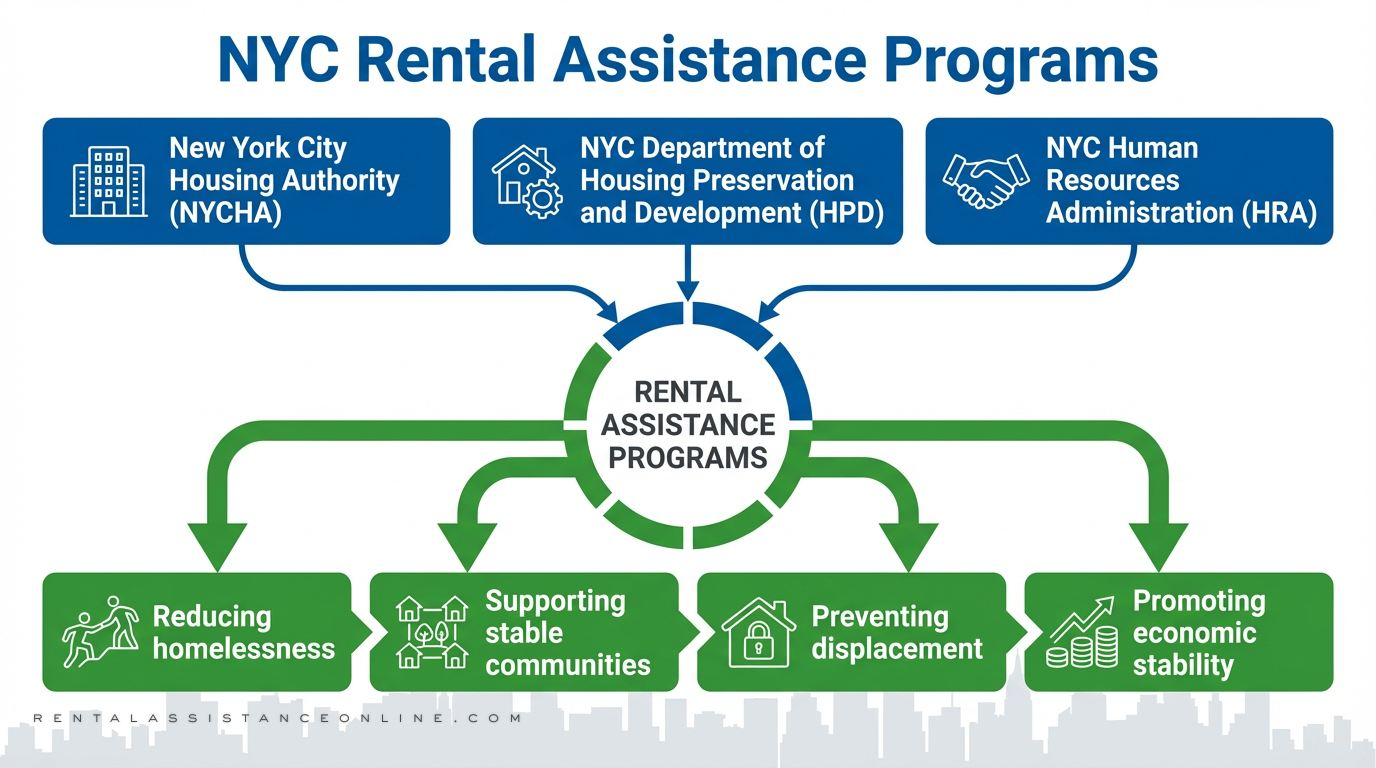
Beyond helping individuals, rental assistance programs also strengthen the city as a whole by reducing homelessness, supporting stable communities, preventing displacement, and promoting economic stability. These programs are a crucial safety net for thousands of households across the five boroughs. For real-world questions and practical guidance on navigating them, the Brooklyn rental assistance guide walks through how the city’s layered system actually works for renters on the ground.
NYC Rental Assistance Eligibility and Application Steps
Eligibility for NYC rental assistance programs generally depends on income, residency, and documentation.
Applying for NYC rental assistance can feel overwhelming — especially if you’re already stressed about rent, late notices, or what happens next. But once you understand the requirements and the basic flow of the process, it gets more manageable.
Common Eligibility Requirements
Although each program has its own rules, applicants generally must live in New York City, meet household income limits based on HUD Area Median Income guidelines, demonstrate financial hardship or housing instability, have a valid lease or rental agreement, and provide identification and household documentation.
Documents Typically Required
Proof of income (pay stubs, tax returns, or benefit letters)
Government-issued identification
Lease agreement (signed copies are often required)
Rent receipts or rent statements
Utility bills
Household member information
Having these documents ready before starting your application can significantly speed up the process. Missing even one common document is a leading reason applications get delayed, so gathering everything upfront is worth the effort.
How to Apply
There are several ways to apply for rental assistance in NYC. Online portals are available through city agency websites. In-person applications can be submitted at housing offices or community organizations. Mail-in forms are accepted for certain programs. And assistance from nonprofit housing counselors is available free of charge for most renters. Many residents begin through HRA or local housing nonprofits — if time is tight, starting with a Homebase office (required for CityFHEPS) or calling 311 gets you into the right queue fastest.
NYC Rental Assistance Resources: Agencies, Nonprofits, and Where to Start
Many organizations across New York City help residents access housing assistance, legal help, and rental support. Below are the most important starting points.
Anti-poverty programs including housing assistance
212-227-6601
These organizations can guide residents through applications, help resolve landlord disputes, and provide emergency financial support. Start with one trusted entry point — HRA, NYCHA, HPD, or a nonprofit counselor — and ask them to point you to the best next step for your specific situation.
Types of NYC Rental Assistance Programs: Vouchers, Public Housing, and Rent Freezes
NYC rental assistance programs can be accessed through city agencies and community partners across all five boroughs.
New York City offers several rental assistance programs tailored to different needs. Understanding what each one offers helps you pursue the right type of support rather than spending time on programs you don’t qualify for.
Major NYC Housing Assistance Programs
Program
Who It Helps
Key Benefit
Section 8 Housing Choice Voucher
Low-income households (at or below 50% AMI)
Portable rental subsidy for private apartments
NYCHA Public Housing
Low-income residents
Rent capped at ~30% of household income
CityFHEPS
Households facing eviction or homelessness (at or below 200% FPL)
Rental voucher covering up to five years of rent
SCRIE
Seniors 62+ in rent-regulated apartments
Permanent rent increase freeze
DRIE
Renters 18+ with qualifying disabilities in rent-regulated apartments
Permanent rent increase freeze
Navigating the Section 8 Voucher Program in NYC
The Section 8 Housing Choice Voucher Program is one of the largest rental assistance initiatives in the United States, locally administered by NYCHA and funded by HUD. Eligible households pay roughly 30% of their monthly adjusted gross income toward rent; NYCHA covers the difference up to its Payment Standard. As of mid-2026, the general NYCHA HCV waitlist is closed and paused — the last general opening was a one-week lottery in June 2024 that placed 200,000 households on the list. Understanding which waitlist programs are actually open right now is worth checking before you spend time applying — this guide to the NYC Section 8 Voucher Program covers the full 2026 waitlist situation.
There are two types of Section 8 vouchers. Tenant-based vouchers are portable between apartments, allow renters to choose their own housing, and must meet program rent limits. Project-based vouchers are attached to specific buildings or developments, offer less flexibility, but can sometimes be easier to secure through individual building waitlists. New York State Homes and Community Renewal (HCR) periodically opens Project-Based Voucher lists at specific NYC buildings — a faster alternative worth monitoring. For households that can’t wait years for Section 8, this overview of rental assistance programs that can work faster than Section 8 is worth reading first.
Finding Landlords Who Accept Vouchers
Some renters worry about finding landlords who accept Section 8 vouchers. Under NYC’s source-of-income protection laws, administered by the NYC Commission on Human Rights, landlords cannot refuse tenants solely because they use housing vouchers. Voucher holders can find participating landlords through NYCHA housing listings, affordable housing lotteries on NYC Housing Connect, and nonprofit housing organizations and tenant advocacy groups.
NYCHA Public Housing: Affordable Apartments for Low-Income Residents
Public housing developments operated by NYCHA provide some of the most affordable housing in the city, with rent capped at approximately 30% of household income. Unlike Section 8 vouchers, public housing units are located in government-owned developments. Key features include access to community centers, educational programs, job training, and maintenance services. Demand is high, however, and waiting lists can run several years. NYCHA is the largest public housing authority in the United States, serving over 400,000 residents across approximately 177,000 apartments.
SCRIE and DRIE: Protecting Seniors and Disabled Renters
SCRIE and DRIE can permanently freeze rent for eligible seniors and disabled renters in rent-regulated apartments.
Two of the most powerful and underused NYC rental assistance programs are SCRIE (Senior Citizen Rent Increase Exemption) and DRIE (Disability Rent Increase Exemption). Both freeze rent for eligible renters — not temporarily, but permanently for as long as you continue to qualify and renew annually. Future rent increases approved by the Rent Guidelines Board are credited to the landlord as a property tax abatement rather than passed on to you.
SCRIE eligibility (2026 update)
Age 62 or older
Legal tenant of record in a rent-regulated apartment (rent-stabilized, rent-controlled, or certain Mitchell-Lama/HDFC co-ops)
Household income at or below $50,000/year (expanded to $75,000 for increases effective July 1, 2026 following state legislation)
Spending more than one-third of monthly household income on rent
DRIE eligibility
Age 18 or older (DRIE has no minimum age beyond 18; SCRIE requires 62+)
Receiving a qualifying federal or state disability benefit (SSI, SSDI, or VA disability)
Legal tenant of record in a rent-regulated apartment
Household income at or below $50,000/year (same July 2026 expansion to $75,000 applies)
Spending more than one-third of monthly household income on rent
Both programs are free to apply for and are administered by the NYC Department of Finance. Apply online at nyc.gov/site/rentfreeze or by calling 311. Note: NYCHA public housing residents are not eligible for SCRIE or DRIE because their rent is already income-capped at 30% under federal law — these programs are for rent-regulated private market apartments only.
How to Maximize NYC Rental Assistance Benefits and Avoid Common Mistakes
Preparing documents early can speed up applications significantly — especially for time-sensitive cases.
Applying for rental assistance is only the first step — how you apply matters just as much as whether you apply. A few practical strategies make a real difference.
Research every available program. Each program serves a different group. Applying to multiple eligible programs increases your chances of receiving help; programs don’t penalize you for applying to others unless you’d receive a duplicate benefit.
Apply early. Many housing programs operate with limited funding and waiting lists, so early applications are essential. When a program like SCRIE or a Project-Based Voucher waitlist opens, the window may be brief.
Maintain accurate documentation. Keep copies of income verification, your lease, rent receipts, and utility bills. A signed lease is required for most programs — this is one of the most commonly overlooked requirements that causes delays.
Know your tenant rights. NYC has some of the strongest tenant protections in the United States. Understanding your rights helps prevent illegal eviction and source-of-income discrimination. If you’re behind on rent and haven’t already applied for help, this guide on rental assistance programs that pay your landlord directly explains how payments typically flow from program approval to your landlord’s account.
Work with housing counselors. Nonprofit housing counselors and legal aid organizations can help you navigate the process, identify the fastest route for your situation, and avoid mistakes that cause delays or denials. If you’re facing an eviction hearing, see this guide on emergency programs that can help you stay in your home for steps to take immediately.
If you’re a working renter
Pull recent pay stubs and bank statements first
Ask your landlord for a current rent ledger
Track deadlines in a notes app or calendar
If you’re helping a family member
Keep a folder with IDs, lease, and benefit letters
Write down every call: date, name, next step
Request reasonable accommodations when needed
If time is tight
Prioritize emergency rental help and legal aid
Submit what you have, then follow with updates
Ask the agency which program moves fastest
NYC Rental Assistance Frequently Asked Questions
What is NYC rental assistance?
NYC rental assistance refers to government and nonprofit programs that help residents pay rent or maintain stable housing through subsidies, rent freezes, and emergency financial support. Programs range from long-term vouchers to one-time grants to permanent rent freeze protections for seniors and disabled renters.
Who qualifies for rental assistance in NYC?
Eligibility depends on income, household size, and housing status. Most programs target low-income households at or below 50–80% of Area Median Income, but programs like CityFHEPS use federal poverty level thresholds, and SCRIE/DRIE serve seniors and disabled renters regardless of AMI as long as they spend more than a third of income on rent.
Can NYC rental assistance programs cover rent arrears?
Yes — several programs, including CityFHEPS and HRA’s One Shot Deal emergency grant, can help cover past-due rent depending on eligibility, timing, and available funding. Ask the agency directly what documentation they need for a rent ledger and arrears proof.
Can landlords refuse housing vouchers in NYC?
No. Under NYC law, landlords cannot discriminate against tenants based on lawful source of income, including housing vouchers like Section 8 or CityFHEPS. The NYC Commission on Human Rights enforces these protections.
What’s the best first step if I don’t know where to start?
Pick one trusted entry point — HRA, NYCHA, HPD, or a nonprofit housing counselor — and ask for a referral to the best-fit program based on your income, household size, and urgency. Calling 311 and asking to be connected to housing assistance is another reliable starting point.
Can I apply to multiple NYC rental assistance programs at once?
Often yes — especially when programs serve different needs. Confirm with the program or a housing counselor first so you don’t unintentionally create a conflict or delay, particularly between programs that require you not to be receiving other assistance.
Affordable housing remains one of the biggest challenges in New York City, but NYC rental assistance programs provide essential support for thousands of residents every year. From Section 8 vouchers and public housing to rent freeze programs for seniors and people with disabilities, these initiatives help prevent homelessness and keep communities stable. If you or someone you know is struggling to afford rent, start with one program, one call, one application — then keep going.
Get Matched to the Right NYC Rental Assistance Program
Find programs that fit your household, reduce trial-and-error, and move faster with a document-ready checklist.
Find programs that fit your household and income level
The Larimer County Emergency Rental Assistance Program (ERAP) helped COVID-19-impacted households cover back rent, current rent, and utility bills — up to 12 months of past-due assistance plus up to 2 months of future rent. The program was administered by Neighbor to Neighbor and funded by the federal government. Residents who still need help should explore current options through the Colorado Emergency Rental Assistance Program.
Emergency rental assistance application resources for Larimer County, CO residents
About the Larimer County Emergency Rental Assistance Program
The Larimer County ERAP was a federally funded initiative that helped households impacted by COVID-19 pay back rent, current rent, and utility bills — keeping families in their homes and preventing eviction. The program was administered in partnership with Neighbor to Neighbor, a Fort Collins-based nonprofit. Residents could apply online or by calling Neighbor to Neighbor at 970-829-0296. For context on how ERAP programs work at the federal level, funding flowed through the Consolidated Appropriations Act of 2021 and the American Rescue Plan Act.
The county’s earlier 2020 Property Owners Program (POP) — which allowed landlords to apply directly — is no longer available. Landlords were directed to use ERAP instead to assist their tenants with rent. The program is not a loan and does not require repayment. Assistance funds came directly from the federal government and were designed solely to help households stay housed during pandemic-related financial hardship.
Both tenants and landlords could apply. To qualify, the following conditions must be met:
Larimer County residency — citizenship is not required. All residents, including undocumented households, were eligible to apply.
COVID-19 financial hardship — the tenant was unable to pay property rent or mobile home lot rent due to the pandemic.
Income at or below 80% AMI — the household’s monthly income must not exceed 80% of the Larimer County Area Median Income.
No duplicate assistance — applicants must not have already received rental assistance covering the same months being requested.
Complete application submitted — the aid application must be fully completed and all required documentation provided.
Tenants could also request utility payment assistance independently. The program explicitly welcomed applications from both property owners and tenants. Other Colorado ERAP programs operated under similar frameworks — renters in neighboring Jefferson County and Adams County faced comparable eligibility requirements and processes.
Behind on rent or utilities in Larimer County? Find out what assistance may still be available to you.
The following documents were required for all applicants. Having everything assembled before starting your application significantly reduces processing time:
Government-issued photo ID for the primary applicant.
Signed lease agreement — signed by both the renter and landlord, listing the applicant as tenant, the rent amount, and the due date. An alternative written tenancy document is acceptable if no formal lease exists.
Proof of income including the applicant’s name and residence — required for all household members 18 or older, and for any minors with income (see income documentation options below).
Utility bills or official correspondence sent to the applicant’s address (required if requesting utility assistance).
Eviction notice (optional but recommended — it helps prioritize your application).
Unemployment benefit letter or statement (optional but used to rank and prioritize applications).
Income Documentation — Choose One Option
Only one option is required for each household member 18 or older:
Option 1 — 2020 tax return: The adjusted gross income, plus the first four pages of the signed return and W-2s. If household members file individually, upload each person’s return and W-2 separately.
Option 2 — Current month income proof: Pay stubs from the last 30 days; unemployment benefit letter plus 30 days of pay stubs; most recent unemployment benefit amount letter; employer letter certifying gross wages (pay rate, hours per week, pay date); current-year Social Security, disability, retirement, pension, or annuity benefit letter showing the gross benefit amount; income verification form for self-employed applicants; or a gig work income ledger.
Option 3 — Government program participation: A letter or documentation confirming household eligibility for TANF, Colorado Works, SNAP, or LEAP within the past year. Households in rent-controlled housing may also use income certification issued within the past year. For assistance, call 1-888-480-0066 or email COERAP@state.co.us.
Pro Tip
Including your eviction notice and proof of unemployment benefits — even though both are optional — moves your application to the front of the queue. Applications with these documents were prioritized over otherwise equivalent submissions. If you’re at risk of eviction, don’t leave these out.
How Much Assistance Can I Receive and What Happens Next
Applicants could request past-due rent for any and all months related to their current residence that remained unpaid, up to a maximum of 12 months. In addition, households could request the current month’s rent plus up to two months of future rent if they planned to remain in the unit and still needed support.
Utility assistance was also available — if electric or natural gas bills had gone unpaid since July 2020, approved funds could clear that outstanding balance entirely. The assistance is a grant, not a loan. No repayment is required under any circumstances.
After submitting, a navigator from Neighbor to Neighbor reviews your application and supporting documents to determine eligibility. They may follow up requesting additional information. There is no fixed processing timeline — earlier submissions stood a better chance as the program operated until funds were exhausted. Tenants facing active eviction proceedings should also review alternatives to eviction in Colorado to understand their full range of options.
Frequently Asked Questions About Larimer County Rental Assistance
Does the Larimer County ERAP cover utility bills?
Yes. Tenants could request utility assistance — covering electric, gas, and other utility bills — alongside or independently of rent assistance. If utilities had gone unpaid since July 2020, approved ERAP funds could clear the outstanding balance entirely. Utility bills or official correspondence sent to your address were required as documentation.
Do I have to be a U.S. citizen to qualify?
No. The Larimer County ERAP was open to all county residents regardless of citizenship or immigration status. The eligibility criteria specified “Larimer County residents (with or without citizenship),” making this one of the more explicitly inclusive programs in Colorado.
Do I need to pay back the rental assistance funds?
No. The Emergency Rental Assistance funds are federal grants — not loans. They do not need to be repaid under any circumstances. The funds were specifically designed to help households remain housed during COVID-19-related financial hardship, with payments going to landlords and utility providers on the tenant’s behalf.
Can a landlord apply for ERAP on behalf of a tenant?
Yes. The Larimer County ERAP accepted applications from both tenants and property owners. Landlords who had tenants behind on rent were encouraged to apply through ERAP. The county’s earlier Property Owners Program (POP) is no longer available, so ERAP was the correct channel for landlords seeking to recover unpaid rent during the pandemic period.
What if I’m currently facing eviction in Larimer County?
Apply for any available rental assistance immediately and include your eviction notice in the application — it improves your prioritization. While your application is pending, contact Neighbor to Neighbor at 970-829-0296 to explain your situation. You should also review alternatives to eviction in Colorado, including legal aid resources and landlord negotiation options that may help pause proceedings.
Behind on Rent in Larimer County? Help May Still Be Available
Colorado state and local programs may still be able to cover your rent and utilities. Connect with an advisor to find out your options today.
What Is EOAC Rental Assistance in Waco, Texas and How Can It Help You Today?
EOAC rental assistance in Waco, Texas connects eligible families in the Heart of Texas region with emergency rent and utility support when funding is available. Through partnerships with local programs and city initiatives, EOAC may help with past-due rent, utilities, or referrals to active housing resources in McLennan County and surrounding areas.
If you’re searching for EOAC rental assistance in Waco, Texas, here’s the simplest, most useful answer:
EOAC (Economic Opportunities Advancement Corporation) helps families in the Heart of Texas connect to emergency rent and utility help, and it has partnered with local programs (including the City of Waco) when funding is available.
Put simply: EOAC may be able to help directly, and even when they can’t, they often know exactly where to send you next.
What EOAC Rental Assistance in Waco Covers and Who Qualifies
EOAC (Economic Opportunities Advancement Corporation) is a community action nonprofit based in Waco, Texas. Their work focuses on helping low-income families stabilize during tough seasons—especially when rent, utilities, or other essentials start slipping out of reach.
EOAC serves families across the Heart of Texas region, including counties such as McLennan, Bosque, Freestone, Hill, Falls, Ellis, Navarro, Johnson, and Limestone.
If you’ve been asking your phone, “Who helps with rent near me in Waco?” or “Where can I apply for emergency rent help in McLennan County?” EOAC is one of the first organizations worth contacting.
EOAC Rental Assistance (Definition): A locally administered support pathway that may provide short-term emergency rent or utility relief through EOAC or its funding partnerships when resources are available.
Does EOAC Provide Direct Emergency Rental Assistance?
This is the question people want answered immediately, so here it is in plain language:
EOAC does not always run a regular, ongoing rental assistance program listed on its main website. But EOAC has partnered with local and city programs in the past to provide direct rental support when funds are available.
For example, in partnership with the City of Waco, EOAC has promoted rental support that could include:
Up to $3,500 for rent (past due, current, or future),
Up to $1,500 for utility assistance,
Possible help with relocation-related fees.
If you want a deeper, local-focused breakdown of EOAC rental assistance tied to Waco and McLennan County programs, that guide can help you understand how support has worked when funding opens up.
Because EOAC programs can depend on funding and partnerships, availability may change over time. That’s why the best move is still the simplest one: call and ask what’s open today.
Emergency and Community Help Through EOAC Programs
If you’re in a crisis—behind on rent, facing a shutoff notice, or worried about eviction—EOAC’s Emergency Assistance services may be able to provide short-term support depending on current resources.
And if you’re trying to understand the bigger picture of what “emergency” help can look like (especially when you’re bouncing between programs and referrals), this overview of emergency housing assistance can help you feel a little less lost and a lot more prepared.
In other words: EOAC is often a starting point, but it can also be a bridge to the right program when you’re not sure what to ask for.
Need EOAC rental assistance in Waco right now? Don’t wait for funding to close—take the first step and find out what programs are open today.
Other Waco Housing Resources Related to EOAC Rental Assistance
Even when rent funding isn’t available directly through EOAC, they often connect people to other organizations that do provide rental help or longer-term housing support.
One of the most important resources in the area is the Waco Housing Authority, which can offer affordable housing options and rental assistance pathways, including Section 8 Housing Choice Vouchers for eligible households.
EOAC may also refer families to transitional housing and shelter programs through local partners, depending on your situation and what’s currently available.
For counseling and longer-term housing stability support, NeighborWorks Waco may be another helpful option. Sometimes the best support isn’t just a one-time payment—it’s getting a plan in place so you can breathe again next month, too.
And if you’re thinking, “Okay… but who else in Texas offers help like this?” browsing a directory-style hub such as Texas emergency rental assistance programs can give you additional leads, especially if you’re outside Waco city limits or you’re helping family in another county.
Housing Stability Data Snapshot:
Rental assistance programs expanded significantly nationwide during emergency funding cycles, helping millions of households avoid eviction.
Local housing authorities administer long-term voucher programs, while community action agencies like EOAC often provide short-term stabilization support.
How to Apply for EOAC Rental Assistance in Waco
If you’re ready to take action (or you’re just trying to stop the situation from getting worse), here are the most practical next steps.
1) Contact EOAC Directly
1800 N. Valley Mills Dr., Waco, TX 76710
Phone: (254) 753-0331
Email: info@eoac.org
When you call, keep it simple and direct. You can say:
“Do you currently have rental assistance available?”
If the answer is no, follow with:
“Can you refer me to any active rent or utility assistance programs in my county?”
2) Call 2-1-1 Texas for Referrals
If you feel stuck, call 2-1-1 Texas. It’s a statewide referral line that can connect you to local rental assistance, housing programs, shelters, food support, and other crisis resources.
3) Contact the Waco Housing Authority
If your bigger need is stable, long-term support—not just a one-time payment—reaching out about Section 8 programs and other housing pathways can be an important step.
Section 8 Housing Choice Voucher (Definition): A federally funded rental assistance program administered by local housing authorities that helps eligible households pay a portion of their rent in the private market.
Important Tips and Common Questions About EOAC Rental Assistance
Rental assistance programs are often tied to available funding, and many operate through local government or nonprofit partnerships—so eligibility and availability can shift. That’s normal, and it’s not your fault if something that helped a neighbor last year isn’t open today.
Before you call, it helps to have key documents ready, because most programs will ask for some version of these:
ID, proof of income, a lease agreement, and any past-due or eviction notices (if you have them).
And if you’re trying to understand why some programs open and close, or how rent-and-utility assistance is structured in general, reading about how federal emergency rental assistance works can help you know what to expect when you apply anywhere.
Common Questions About EOAC Rental Assistance
Can EOAC rental assistance pay my back rent?
Possibly. When funding is available through partnerships or emergency support, EOAC may be able to help. The fastest way to know is to contact them directly and ask what’s currently open.
Does EOAC help with utilities in Waco?
Utility support may be available depending on current funding and program availability, especially through emergency assistance services.
Is EOAC rental assistance the same as Section 8?
No. Section 8 is administered through housing authorities. EOAC may refer you there, but it does not manage Section 8 directly.
What if EOAC can’t help me today?
Ask for referrals. EOAC can often point you to another agency, county program, or nonprofit partner that has open funding right now.
The Quick Takeaway on EOAC Rental Assistance in Waco
If you’re behind on rent or worried about eviction in Waco or the surrounding Heart of Texas region, EOAC should be one of your first calls.
Even when they don’t have direct rent funds available, they often know who does. And when you’re stressed, exhausted, and trying to keep a roof over your head, that kind of guidance can make all the difference.
Take the Next Step Toward Stable Housing in Waco
If EOAC rental assistance could be the support you need, don’t wait for the situation to escalate.
Find out what rent and utility programs are open today
Get pointed to the right agency fast
Understand your eligibility before funding runs out
Move from crisis to stability with clear next steps
Howard County’s COVID-19 Emergency Rental Assistance Program, administered by the Howard County Department of Housing and Community Development (DHCD), exhausted all available rental assistance funds as of February 3, 2022. Foreclosure prevention funds remained available beyond that date. Howard County residents who still need housing help should contact DHCD directly or explore statewide programs through the Maryland rental assistance program.
Emergency rental assistance application resources for Howard County and the Baltimore region, Maryland
About the Howard County COVID-19 Housing Assistance Program
Howard County’s emergency housing assistance initiative was designed to help county residents impacted by the COVID-19 outbreak cover rent, utility bills, and mortgage payments — preventing both eviction and foreclosure during a period of widespread economic hardship. The program was funded through federal ERA allocations under the Consolidated Appropriations Act of 2021 and the American Rescue Plan Act and administered locally by the Howard County Department of Housing and Community Development (DHCD).
Program Status Update
As of February 3, 2022, Howard County DHCD exhausted all available funding for rental housing assistance. If additional funds become available, the county intends to work with existing community partners to resume assistance for rental households impacted by COVID-19. Foreclosure prevention assistance remained available beyond this date — contact DHCD directly for current status.
For Howard County residents still seeking help, the statewide Maryland ERAP framework continues to evolve. The Maryland ERAP application guide provides an up-to-date overview of which programs are currently accepting applications across the state and how the county-level system is structured.
What the Howard County COVID-19 Housing Program Covered
While active, the Howard County program was broader in scope than many county-level ERAP initiatives, covering three categories of housing costs rather than just rent:
Rent assistance: Financial aid for past-due rent payments to help tenants avoid eviction.
Utility bill assistance: Help covering electricity, gas, water, and other household utility costs for COVID-19-impacted residents.
Mortgage and foreclosure prevention: Assistance for homeowners struggling with mortgage payments — and notably, this funding stream had remaining availability even after rental assistance was exhausted in February 2022.
The inclusion of mortgage assistance set Howard County’s program apart from many other Maryland county ERAP initiatives, which were typically renter-only. Homeowners facing foreclosure in Howard County should contact DHCD directly to confirm whether any foreclosure prevention funds remain available under current program cycles.
Behind on rent, utilities, or mortgage in Howard County? Find out what help may still be available to you.
Where to Find Rental Assistance in Howard County Now
With Howard County’s local rental assistance exhausted, residents need to look to statewide and regional resources. Maryland’s ERAP is administered at the county level, so your first step is identifying which programs are currently active in your area.
How to navigate the rental assistance application process in Maryland
The Baltimore City Eviction Prevention Program is one of the most active in the region, providing up to 15 months of back rent and tenant assistance services to qualifying city residents. Howard County residents who work in Baltimore or have ties to the city may want to check whether they meet Baltimore’s residency requirements.
In adjacent Anne Arundel County, the Anne Arundel County Eviction Prevention Program continues to focus exclusively on tenants at immediate risk of eviction. Similarly, Harford County’s ERAP prioritizes households with incomes at or below 50% AMI and those with at least one member unemployed for 90 or more days.
Pro Tip
Maryland’s ERAP system is decentralized — each county runs its own program with its own eligibility rules, funding cycles, and application portals. Just because Howard County’s rental funds are exhausted does not mean neighboring counties are in the same position. Always check multiple county programs if you live near a county border.
How to Apply for Maryland Rental Assistance in 2025
For Howard County residents seeking assistance through the statewide system, the process typically follows these steps:
Gather required documents before starting: proof of income, government-issued photo ID, current lease or rental agreement, documentation of COVID-19 financial impact, and any eviction notice received.
Apply through the relevant county or municipal portal. Most programs accept online submissions; in-person assistance is available at designated community centers in the Baltimore region.
Respond promptly to any follow-up requests from program staff — incomplete documentation is the most common cause of processing delays across Maryland ERAP programs.
The full statewide picture is covered in the Maryland rental assistance guide, which is updated regularly to reflect current program availability and income thresholds across the state.
Documentation and eligibility requirements for Maryland rental assistance programs
Frequently Asked Questions About Howard County Rental Assistance
Is the Howard County rental assistance program still accepting applications?
No. Howard County DHCD exhausted its rental assistance funding as of February 3, 2022. The county stated its intent to seek additional funding and resume assistance if more becomes available. Contact Howard County DHCD directly to check current program status, and explore other Maryland county programs in the meantime.
Is foreclosure prevention assistance still available in Howard County?
As of the program’s last update, foreclosure prevention funds remained available in Howard County even after rental assistance was exhausted. Homeowners facing foreclosure should contact Howard County DHCD to confirm whether foreclosure prevention assistance is currently active and how to apply.
Where can Howard County residents apply for rental assistance now?
Howard County residents should check the Maryland Department of Housing and Community Development’s county directory for currently active programs. Neighboring counties — including Baltimore City, Anne Arundel, and Harford — have their own ERAP programs with separate funding cycles. Applying to multiple county programs (where you meet residency requirements) may improve your chances of receiving assistance.
What documents are typically required for Maryland ERAP applications?
Most Maryland ERAP programs require: a government-issued photo ID, proof of income (pay stubs, W-2s, or unemployment determination letters), a current lease or rental agreement, documentation of financial hardship, and an eviction notice if one has been issued. Some programs accept alternative documentation if standard documents are unavailable — a case manager can advise.
How long does it take to get approved for Maryland rental assistance?
Most applicants receive a response within 30 to 45 days, though this varies by county and current application volume. Submitting complete, accurate documentation from the start is the single most effective way to avoid delays. Respond quickly to any requests for additional information, which are typically made by email or phone, and follow up with the program’s help desk if you haven’t heard back after 45 days.
Need Housing Help in Howard County? Don’t Wait
Maryland programs may still be able to help with rent, utilities, or foreclosure prevention. Connect with an advisor to find out your options today.
Hidalgo County, TX residents who need help with rent, deposits, or utilities can contact the Hidalgo County Community Service Agency, the Salvation Army in McAllen, or the McAllen Housing Authority. Section 8 Housing Choice Vouchers and the Emergency Solutions Grant program are also available to qualifying low-income households.
Rental and utility assistance resources for Hidalgo County and McAllen, Texas residents
How the Hidalgo County Community Service Agency Helps Renters
The Hidalgo County Community Service Agency is the county’s primary hub for housing and social support, serving low-income and vulnerable households across the Rio Grande Valley. Its mission centers on improving quality of life and promoting long-term self-sufficiency — not just meeting immediate needs but helping residents build financial stability over time. The agency coordinates funding from multiple sources and partners with community organizations to deliver a wide range of services. For a broader understanding of how emergency rental assistance programs work at the federal level, the agency’s housing programs draw from many of the same funding streams used by counties nationwide.
Services available through or coordinated by the agency include food assistance, housing support, utility bill help, job training programs, and targeted assistance for seniors, people with disabilities, and migrants. The goal is to address both immediate crises and the underlying conditions that create them — helping Hidalgo County residents move toward greater independence and economic stability.
Where to Get Help With Back Rent and Deposits in McAllen
Two organizations in McAllen specifically offer direct assistance with back rent and housing-related costs for Hidalgo County residents facing financial hardship.
The Salvation Army — McAllen Corps
The Salvation Army operates corps centers in McAllen and other Hidalgo County communities with funds specifically designated for back rent, housing deposits, and emergency housing-related costs. Beyond rent assistance, the Salvation Army in Hidalgo County provides emergency shelter, utility bill grants, transportation assistance, and specialized help for migrants, elderly residents, and single parents with dependent children. The organization works actively to prevent evictions across the county and can also connect qualifying households with free furniture. To inquire about availability or apply for help, contact the McAllen Salvation Army corps directly at (956) 682-1468.
McAllen Housing Authority
The McAllen Housing Authority, located at 1200 N 25th St., helps income-eligible individuals and families access affordable housing through federally funded programs including Section 8 Housing Choice Vouchers. Staff can provide guidance on qualifying for vouchers, locating participating landlords, and navigating the application process. If you are currently behind on rent or struggling to cover a deposit, contacting the McAllen Housing Authority is a strong first step toward securing long-term housing support.
Key Contacts at a Glance
Salvation Army McAllen:(956) 682-1468 — back rent, deposits, utility grants, emergency shelter
McAllen Housing Authority: 1200 N 25th St., McAllen — Section 8 vouchers and affordable housing guidance
Hidalgo County CSA:hidalgocounty.us — full range of housing and social services
Behind on rent in Hidalgo County? Find out what assistance programs you may qualify for today.
Section 8 Housing Choice Voucher Program in Hidalgo County
The Housing Choice Voucher Program — widely known as Section 8 — is a federal program administered locally that helps low-income families, elderly individuals, and people with disabilities afford safe and decent housing. Under this program, voucher holders pay a portion of their rent directly to their landlord, and the voucher covers the remainder up to a locally established payment standard. This makes the program one of the most impactful long-term rental assistance options available in the county, particularly for low-income families in Texas who face ongoing affordability challenges.
Section 8 applications in Hidalgo County have been accepted during open enrollment periods at the designated Weslaco, TX location during weekday morning hours. Because waitlists open and close based on available funding, prospective applicants should contact the McAllen Housing Authority directly to confirm current enrollment status.
Family Self-Sufficiency Program
Section 8 recipients in Hidalgo County may also be eligible for the Family Self-Sufficiency (FSS) Program, a HUD-funded initiative that helps voucher holders build financial independence alongside their housing assistance. Participants enter a five-year contract and work toward goals such as higher education, job training, improved credit scores, or increased earnings. Dedicated case managers support participants throughout the process. This program is especially valuable for households looking to transition off long-term housing assistance and build lasting economic stability.
Open to current Section 8 voucher holders in Hidalgo County.
Five-year contract with individualized self-sufficiency goals and case management support.
Goals can include job training, credit building, education, or income growth.
An escrow savings account is built during participation, available upon successful completion.
Pro Tip
Section 8 waitlists in Texas can be long. Don’t wait until you receive your voucher to explore short-term resources. The Salvation Army and Hidalgo County Community Service Agency can provide bridge assistance while you wait for a voucher to become available. Other Texas renters in similar situations can also review emergency housing voucher options available elsewhere in the state.
Additional Rental Assistance Resources in Hidalgo County
Beyond the core programs listed above, several additional resources are available to Hidalgo County residents who need help with rent, utilities, or housing stability:
Emergency Solutions Grant (ESG): A federally funded program administered by Hidalgo County that provides emergency housing assistance, including rapid re-housing and homelessness prevention services for qualifying households.
Salvation Army, Hidalgo County: In addition to the McAllen corps, the Salvation Army has multiple points of service across Hidalgo County offering case-by-case emergency housing help.
City of Donna assistance programs: The City of Donna operates its own local assistance programs for residents within city limits. Contact the City of Donna directly for current program availability.
Statewide Texas rental assistance: Renters who exhaust local options can explore broader programs outlined in the Texas rental assistance guide, which covers county-level and state-administered programs across the state.
Frequently Asked Questions About Hidalgo County Rental Assistance
How do I get emergency rent help in McAllen, TX?
The fastest route for emergency rent help in McAllen is to contact the Salvation Army corps at (956) 682-1468. They maintain funds for back rent, deposits, and utility bills on a case-by-case basis. The Hidalgo County Community Service Agency is also a strong referral point and can connect you with other programs you may not be aware of.
Who qualifies for Section 8 in Hidalgo County?
Section 8 Housing Choice Vouchers in Hidalgo County are available to low-income families, elderly individuals, and people with disabilities whose household income falls within HUD’s established limits for the area. Applications are only accepted during open enrollment periods, which are announced in advance. Contact the McAllen Housing Authority at 1200 N 25th St. to confirm whether the waitlist is currently open.
What is the Emergency Solutions Grant in Hidalgo County?
The Emergency Solutions Grant (ESG) is a HUD-funded program administered by Hidalgo County that provides short-term rental assistance, utility help, and homelessness prevention services. It is designed for households at imminent risk of losing their housing. Applications and eligibility details are managed through the Hidalgo County Community Service Agency.
Does the Salvation Army in Hidalgo County help with utility bills?
Yes. In addition to back rent and deposit assistance, the Salvation Army corps centers in Hidalgo County provide grants for utility bills including electricity and gas, as well as transportation assistance. Services are offered on a case-by-case basis and subject to available funding. Call (956) 682-1468 to check current availability.
What is the Family Self-Sufficiency Program and how do I join?
The Family Self-Sufficiency (FSS) Program is a voluntary HUD initiative available to Section 8 voucher holders. Participants sign a five-year contract and work toward personal financial goals — such as education, job training, or income growth — with support from a dedicated case manager. As income increases, an escrow account grows and is released to participants who complete the program. To enroll, contact the McAllen Housing Authority.
Need Rent Help in Hidalgo County? Don’t Wait
Programs in McAllen and across Hidalgo County may be able to cover your rent, utilities, or deposit. Get connected today.
The Montana Emergency Rental Assistance Program helped COVID-19-impacted residents avoid eviction or foreclosure through rent, utility, internet, and late fee assistance — up to 15 months under ERA1 and up to 18 months combined with ERA2. Administered by Montana Housing and funded by federal grants ERA0425 and ERAE0032, the program served both tenants and landlords. Check Montana Housing’s portal for current funding availability.
Emergency rental and utility assistance application resources for Montana residents
About the Montana Emergency Rental Assistance Program
Montana’s Emergency Rental Assistance program was created to help state residents who faced the risk of losing their homes due to COVID-19-related financial hardship. The program covered both the Emergency Rental Assistance (ERA) program and the Homeownership Assistance Fund — making it one of the broader statewide relief initiatives, serving renters and homeowners. To understand how federal ERAP programs work, Montana’s program drew from two distinct federal funding streams administered by the U.S. Department of the Treasury.
Funding came from two federal acts — the Consolidated Appropriations Act (ERA1) and the American Rescue Plan Act (ERA2) — and was appropriated by the 67th Montana Legislature through House Bill 3, House Bill 630, and House Bill 632. The program was administered by Montana Housing, the state’s housing agency. For a current picture of what is still available nationwide, the emergency rental assistance 2026 guide covers how to find active programs quickly when pandemic-era funding has wound down.
Households that qualified could receive assistance for costs accrued on or after April 1, 2020. Eligible expense categories included:
Past-due and future rent — up to a maximum monthly rent of $2,200.
Home energy utility bills — current and future utility costs, up to $500 per eligible utility per month (increased from $300 effective February 22, 2022).
Internet service — past-due and future internet costs, capped at $50 per month.
Reasonable late fees on past-due rent, as supported by the lease agreement or landlord verification.
Security deposits that had not been paid.
Rental property application and credit check fees.
How Much Assistance Is Available and for How Long
Under ERA1 (Consolidated Appropriations Act)
Combined past-due and future rent and utility assistance generally cannot exceed 12 months.
An additional three months (for a total of 15) may be granted if needed to preserve housing stability, subject to available funding.
Priority is given to clearing past-due rent and energy bills before approving future payments.
Future rent assistance is limited to three months per application.
Under ERA2 (American Rescue Plan Act)
Combined past-due and future rent and utility assistance cannot exceed 18 months.
Future rent assistance remains capped at three months per application.
Applicants who received the full 15-month maximum under ERA1 may qualify for up to three additional months under ERA2.
Behind on rent or utilities in Montana? Find out what programs may still be available to you.
Montana was required by the U.S. Department of the Treasury to prioritize households with the greatest need. Priority was given to:
Households with income at or below 50% of the Area Median Income (AMI).
Households with one or more members unemployed for 90 or more consecutive days before the date of application.
The overall income limit was 80% of AMI. Montana Housing conducted regular reviews of approved applicants to verify that the majority of assisted households fell within the 0–50% AMI range, in line with federal prioritization requirements. Based on 2021 program data, 89% of assisted households had incomes below 50% of AMI. The federal emergency rental assistance framework provides additional context on how these income standards were set and applied nationally.
How to Apply for Montana Rental Assistance: Three Steps
Montana Housing structured the application process in three sequential steps. Completing Steps 1 and 2 before starting the formal application significantly improved approval rates.
Gather required documents and set up your Okta account — Review the application preparation guide at Montana Housing to understand exactly what documents are needed and how to create an Okta account (required to access the application portal). Detailed setup instructions were also available in walkthrough videos produced by Montana Housing.
Submit your application — Once Steps 1 and 2 are complete, apply through montana.servicenowservices.com/mera. Separate tenant and landlord application guides were available; landlords were also required to complete their portion of any joint application.
Pro Tip
Applications are only considered “Submitted” when both the tenant and the landlord have completed their portions. If either side is incomplete, the application sits in “New” status and cannot be reviewed. Notify your landlord immediately after starting an application so they can complete their section without delay.
What Happens After You Submit Your Application
After submission, your application moves through five stages tracked in the online portal:
New — One party has completed their portion; the other has not yet done so.
Submitted — Both the tenant and landlord have completed their portions.
In Review — Montana Housing staff are reviewing eligibility and verifying documentation.
Quality Control Review — A secondary reviewer verifies payment calculations and confirms all information needed to execute payment is present.
Approved — Quality Control has cleared the application. An authorized Montana Housing manager approves payment, which is entered into the state accounting system. Check payments may take 7 to 10 business days to arrive.
If information is missing, the application may be flagged as “tenant pending information” or “landlord pending information” — respond promptly to avoid delays. Applicants found ineligible receive an email explaining the reason for denial. Montana residents currently facing eviction should also review alternatives to eviction alongside any assistance application, as legal aid and payment plan negotiation can help buy time while assistance is processed. For a broader list of programs that may still be active, the Montana rental assistance guide on this site is kept updated as program status changes.
Frequently Asked Questions About Montana Rental Assistance
Does the Montana ERAP cover internet bills?
Yes. Internet service was an eligible expense, capped at $50 per month. Both past-due and future internet costs were covered, making the Montana program notably more comprehensive than many other state ERAP initiatives, which typically excluded broadband.
Can Montana homeowners receive assistance through ERAP?
Yes, in part. The Montana program included a Homeownership Assistance Fund alongside the rental program. Homeowners could receive assistance with home energy utility bills — up to $500 per eligible utility per month. Mortgage assistance was handled through the separate Homeownership Assistance Fund component rather than the rental ERAP directly.
What is an Okta account and why do I need one?
Okta is a secure identity verification platform used by Montana Housing to authenticate applicants and protect sensitive personal information. You must create an Okta account before accessing the ERAP application portal. Montana Housing provided step-by-step video walkthroughs for both tenant and landlord Okta setup. Complete this step before beginning your application to avoid being blocked mid-process.
How long does it take to receive payment after approval?
Approved payments are entered into the state accounting system daily. Electronic fund transfers (EFTs) are typically faster than check payments. Check payments may take 7 to 10 business days from the date of approval. Payment speed depends on which disbursement method the landlord or utility provider accepts.
What happens if I was denied — can I appeal or reapply?
Applicants found ineligible receive an email notification explaining the specific reason for denial. Review the explanation carefully — if a document was missing or a question was answered incorrectly, you may be able to address the issue and reapply. Contact Montana Housing through the program FAQ page or the application portal for guidance on next steps after a denial.
Need Help With Rent or Utilities in Montana?
State and federal programs may still be able to help. Connect with an advisor to find out what options are available to you today.